

Use Case
Dynamic Demand-Control Ventilation
Ventilate for the room that's actually occupied, not the schedule.
Fresh-air ventilation that responds to real-time occupancy and indoor air-quality data instead of a fixed timetable — keeping air quality where it needs to be without ventilating empty rooms at full rate.
The problem
Fixed ventilation schedules waste energy on rooms nobody's in
Most HVAC systems ventilate on a fixed schedule sized for worst-case occupancy — so a half-empty conference room or an out-of-hours office is often conditioned at full rate regardless of who's actually there.
Fresh outdoor air is essential for healthy indoor environments, but conditioning that air — heating, cooling and dehumidifying it — accounts for a significant share of a building's total energy consumption. Running that process at full rate for an empty or lightly occupied room is money spent on nobody.
The result is unnecessary energy spend on one side, and — when occupancy spikes beyond what the schedule assumed — under-ventilated, stuffy spaces on the other.
Issue → solution
What demand-control ventilation actually fixes
The issue
Ventilation is set for worst-case occupancy, all day, every day.
Hover to see the fix →
XiGiFy solution
Airflow adjusts automatically to who's actually in the room, in real time.
The issue
HVAC is usually a building's single biggest energy draw.
Hover to see the fix →
XiGiFy solution
Ventilate only when and where it's needed, cutting wasted conditioning without new mechanical hardware.
The issue
Sustainability and green-building targets need airflow data, not estimates.
Hover to see the fix →
XiGiFy solution
Occupancy, CO₂ and energy trends feed directly into ESG and building-performance reporting.
The issue
Retrofitting ventilation controls usually means ripping out existing HVAC.
Hover to see the fix →
XiGiFy solution
Works alongside your existing HVAC and BMS — sensors and control logic layer on top, not a system replacement.
The issue
When a room fills up faster than the schedule assumed, it gets stuffy.
Hover to see the fix →
XiGiFy solution
Airflow increases as occupancy and CO₂ rise, so busy spaces stay in range instead of catching up later.
The issue
A comfort complaint is often the only signal a team gets that ventilation is off.
Hover to see the fix →
XiGiFy solution
Every zone is tracked continuously on occupancy, CO₂, temperature and humidity, so conditions are visible first.
How it works
Occupancy and air quality drive airflow, not the clock
- Step 01
Sense
Occupancy and CO₂, temperature and humidity sensors continuously track how a space is actually being used.
- CO₂, temperature and humidity tracked by zone
- Air mass flow and differential pressure alongside occupancy
- Formaldehyde and PM2.5 sensing added where needed
- Step 02
Analyze
The platform compares real-time conditions against target thresholds for each zone.
- Each zone measured against its own target range
- Occupancy and CO₂ trends read together, not one reading
- Rising demand spotted before a threshold is crossed
- Step 03
XiGiFy Brain
Adjust
The platform's decisioning layer turns that comparison into an action — automatically adjusting airflow to match actual demand, increasing ventilation as occupancy or CO₂ rises and easing back when a space empties out.
- Control signals sent to VAV systems and the existing BMS
- Airflow ramps up ahead of a threshold and eases back as a space empties
- Runs continuously without technician intervention
- Step 04
Report
Air-quality and energy-use trends feed into building performance reporting and ESG data.
- Air-quality and energy trend tracked separately per zone
- Under-performing zones stay visible, not averaged away
- Supports ASHRAE 62.1 and EN 16798-1 documentation
The difference it makes
Static ventilation vs. adaptive ventilation
A fixed schedule ventilates every zone the same way regardless of who is in it. Adaptive ventilation reads the building as it actually is and sets airflow zone by zone.
Before
Static ventilation
One airflow rate for every zone, sized for worst-case occupancy and held all day — conditioning empty rooms at full rate while busy ones fall behind.
After
Adaptive ventilation
Airflow set per zone against live occupancy and air-quality readings, rising as a space fills and easing back as it empties.
What it reads
Occupancy
How many people are actually in each zone right now.
Indoor CO₂
The clearest live indicator of whether a space is under-ventilated.
Temperature & humidity
Tracked by zone alongside CO₂ so comfort is not traded away for efficiency.
Target thresholds
The air-quality range each zone is expected to stay inside.
What it produces
Better health and Hygiene
Occupied spaces stay within healthy CO₂ and humidity ranges — conditions that directly support occupant health and well-being.
Less wasted energy
Ventilation stops running at full rate for rooms that nobody is in.
Zone-level control
Every zone is set on its own conditions rather than one building-wide schedule.
Estimator
How much HVAC energy demand-control ventilation could take out
Pick a city and building size for a first-pass estimate. Every assumption below is editable — replace the defaults with your own figures for a closer read.
UAE
Estimated reduction in HVAC energy
14–22%
of the estimated 4,100 MWh this building uses on HVAC each year in Dubai
574–902
MWh avoided / year
230–361
tonnes CO₂e / year
$63,140–$99,220
at your tariff / year
How this is calculated. Floor area × HVAC intensity × building-type factor gives annual HVAC electricity; the saving range applies 14–22% to it for Dubai. The range changes by city because the saving depends on how much energy it takes to condition outdoor air in that climate. No city is set above the 22% reduction XiGiFy measured in its own demand-control ventilation proof-of-concept deployments in Dubai.
These are illustrative figures. The default tariff, HVAC intensity, grid emissions factor and savings range are order-of-magnitude planning values for each city, not audited benchmarks for your building. Actual results depend on your systems, occupancy patterns and tariff. This is a planning estimate, not a quote or a guarantee.
How the estimate compares by city
Same building size and type, held constant — each city's own tariff and HVAC intensity is what moves the estimate, along with its own savings range. Upper-bound saving shown.
Click a city to load it into the estimator above. Differences come from each city's illustrative tariff, HVAC-intensity and savings-range defaults. The 22% measured in Dubai is the highest upper bound used for any city.
Capabilities
What's included
Occupancy-based control
Airflow adjusts to real occupancy signals instead of a fixed timetable — the same closed loop between sensing, analysis and BMS actuation that proven deployments at a leading Dubai real estate group and Dubai City Walk used to achieve a 22% reduction in ventilation energy use.
Multi-parameter sensing
CO₂, temperature, humidity, air mass flow and differential pressure tracked continuously by zone — the control parameters required for reliable, ASHRAE 62.1–aligned ventilation strategies. Formaldehyde and PM2.5 can be added where building chemistry or IAQ certification requires it.
VAV & BMS actuation
Control signals feed directly into Variable Air Volume (VAV) systems and existing BMS (BACnet, Modbus) to adjust outdoor-air supply and airflow — closing the loop between sensing and the mechanical system, not just producing a dashboard.
Autonomous operation
Once the control logic is configured, the platform adjusts ventilation continuously without technician intervention — no manual override needed each time occupancy changes.
Air-quality-first logic
Ventilation responds to actual conditions, so occupied spaces stay within target air-quality ranges without over-conditioning empty rooms.
Predictive pre-conditioning
Trends in occupancy and CO₂ let airflow ramp up before a zone crosses its threshold, instead of reacting only after it's already out of range.
ASHRAE 62.1 / EN 16798-1 alignment
Demand-based ventilation control aligns with ASHRAE 62.1 Ventilation Rate Procedure and EN 16798-1 occupancy-based airflow strategies, supporting green-building and compliance documentation.
Zone-level reporting
Every zone's air-quality and energy trend is tracked separately, so a persistently under-performing zone is visible rather than averaged into a building-wide number.
Use cases
Where this fits
- Commercial office buildings and conference facilities
- Educational institutions with variable classroom occupancy
- Healthcare facilities
- Shopping centres and public spaces with fluctuating footfall
- Multi-tenant and portfolio buildings targeting measurable energy reduction
Deployment
Integrations & rollout
Works alongside existing HVAC, Variable Air Volume (VAV) systems and building management systems via BACnet or Modbus — no new mechanical hardware required. Connects with XiGiFy's IAQ monitoring for a unified air-quality and energy data view.
Occupancy and air-quality sensors are installed by zone; the platform continuously compares live conditions to target thresholds and drives VAV and BMS outputs accordingly.
Deployed
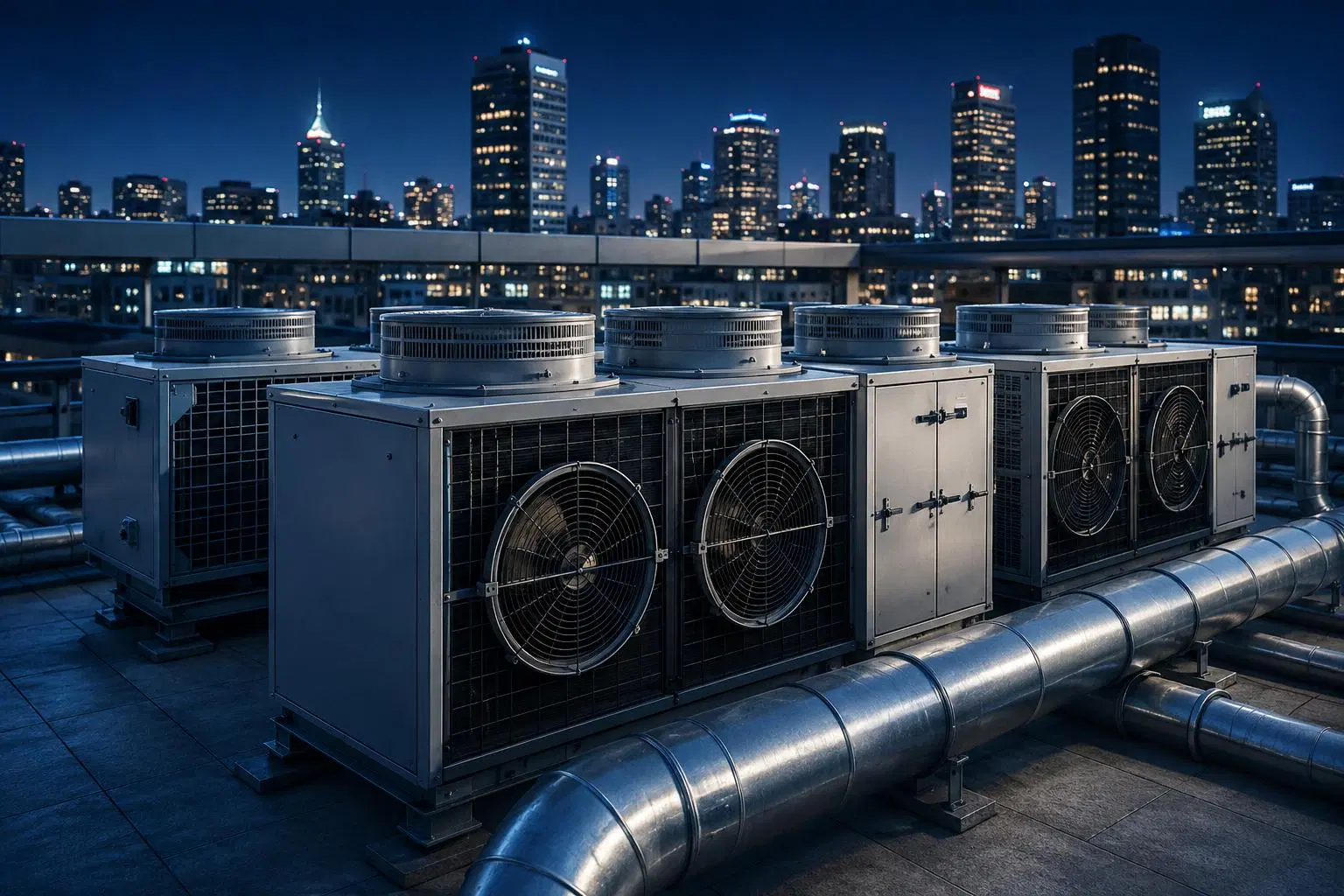
Dynamic Demand-Control Ventilation in the field


Works well with
Related use cases
Relevant industries
Where this use case is commonly applied
FAQ
Questions about dynamic demand-control ventilation
See dynamic demand-control ventilation on your own sites.
Tell us what you want to monitor and we'll walk you through how it would work for your facilities.